

Bringing $1.35M in Prediction Market Trading: Zero Drift's AI Audit of Insiders.bot

Overview
Prediction markets have crossed from curiosity into trading infrastructure.
In 2026 alone, major platforms such as Polymarket and Kalshi have been reported processing more than $20B in monthly trading volume. Around that volume, bots, smart-money tracking, copy trading, Telegram execution, and automated strategies are becoming part of the market structure.
Insiders.bot sits directly inside that shift. It is still early compared with the full prediction-market category, but its public-beta traction shows why trading terminals are becoming an important layer around Polymarket and similar venues.
Zero Drift recently completed an AI-native security review of Insiders.bot's wallet-manager contract on Polygon. For a product built around faster signals and faster execution, the wallet manager is not a back-office component. It is part of the trust boundary between user intent and asset movement.
What Insiders.bot Is Building
Insiders.bot is building a prediction-market trading terminal: a command center for discovering markets, tracking profitable wallets, reading signals, and executing quickly.
Its product surface includes smart-money alerts, wallet profiles, market analytics, copy trading, Telegram workflows, one-click execution, and trading controls such as limit orders and automated exits. The core idea is simple: prediction markets are information-sensitive, and traders want to shorten the path from signal to action.
That product category is becoming more important as prediction markets accelerate. Dune's research on Polymarket fast markets found that shorter-duration markets have become heavily automated, with bots and high-frequency traders driving a major share of activity. Polymarket's Builder Program also gives third-party apps, bots, terminals, and trading interfaces a supported route into the CLOB.
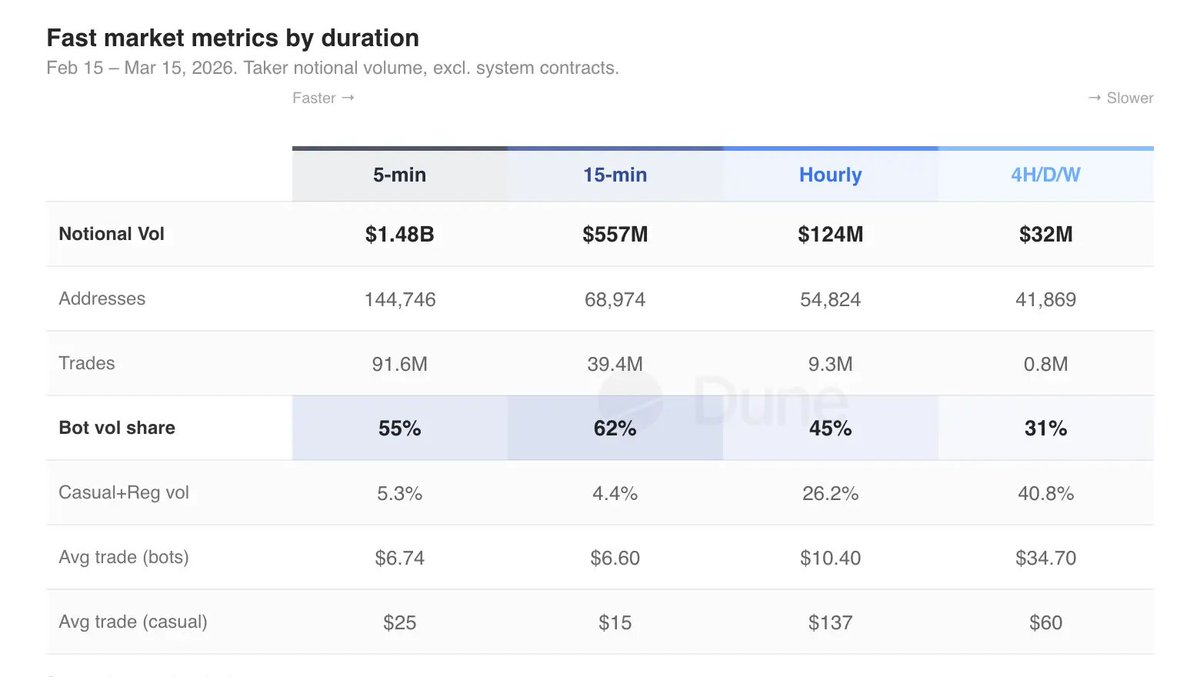
Bots have become major participants in shorter-duration prediction markets.
Insiders.bot is one of those interfaces. It generated $1.35M in trading volume during its public beta with zero marketing spend.
The broader lesson is not that Insiders.bot is already a massive venue. It is that even early-stage prediction-market terminals can quickly become execution infrastructure. Once users approve funds, delegate actions, or automate trades, the security model changes.
Why the Wallet Manager Matters
A trading terminal is valuable because it removes friction. A user can see a signal, check market depth, follow a smart wallet, and place a trade faster than they could through a generic interface.
But less friction also means more responsibility.
If a product only displays analytics, the security boundary is mostly around data quality and account access. If it can help move assets, mirror trades, or execute against approvals, the security boundary moves closer to user funds. The wallet manager becomes the control plane for user intent, permissions, and operational safety.
For a terminal like Insiders.bot, wallet-manager security is therefore product security. Users come for speed, but they stay only if speed does not weaken control.
The Audit
Zero Drift reviewed Insiders.bot's wallet-manager contract on Polygon. The review focused on the contract's withdrawal model, role configuration, destination controls, cooldown behavior, deployment state, and operational trust assumptions.
At a high level, the intended model is that users approve the manager, configure withdrawal destinations, and rely on contract-level controls to constrain asset movement. Zero Drift tested whether that model remained true under realistic operating conditions.
Zero Drift helped identify several critical risks in the wallet-manager trust model, and the Insiders.bot team is working through fixes.
Zero Drift's goal was to reduce the gap between product speed and contract safety.
For Insiders.bot, that meant mapping the wallet manager against the actual needs of a prediction-market terminal: delegated execution, user-configured destinations, automation, admin operations, and fast-moving funds.
The review produced practical remediation guidance for reducing unnecessary trust, clarifying permission boundaries, and making the wallet-manager model safer as trading volume grows. The core principle was straightforward: the user's configured intent should be the hard boundary, even when automation or operators are involved.
That is especially important for terminals. In a dashboard, security protects data and accounts. In an execution terminal, security protects the path between signal and settlement.
Looking Ahead
Prediction markets are becoming faster, more automated, and more competitive. Dune's research on Polymarket fast markets shows how quickly market structure can change once time windows compress and bots enter the flow. Terminals like Insiders.bot are a natural response to that environment: traders need better information, faster execution, and tools that feel closer to professional trading software.
But as terminals become more powerful, their contracts become more important. Wallet managers, copy-trading permissions, approval flows, and operator roles are where convenience meets custody.
That is exactly where audits need to focus.
Zero Drift provides AI-assisted smart contract audits for teams building trading terminals, bots, wallet managers, DeFi infrastructure, and other systems where speed and automation touch real capital. AI helps accelerate code understanding, threat modeling, state inspection, and finding validation. Human review keeps the work grounded in business logic, deployment reality, and adversarial thinking.
If your product is moving from analytics into execution, get the wallet and permission layer reviewed before users depend on it.